Best for
- Buyers choosing between an audio-led routine and a visual guided course
- Beginners comparing pronunciation practice without treating software as a tutor
- Learners checking whether one-language depth or broad language access matters
Watch for
- Pimsleur course depth varies by language even though All Access covers the catalogue
- Rosetta Stone's contextual prompts may not suit learners who want frequent explicit grammar explanation
- A free trial and a money-back guarantee create different payment obligations
Products in this decision
Every merchant destination on this page is an ordinary link. Affiliate availability and commission are not ranking inputs.
Pimsleur
DocumentedAn audio-first programme centred on recall, speaking and listening in roughly 30-minute lessons.
Best fit: Audio learners and commuters
Watch: Reading and writing are secondary to audio
Rosetta Stone
DocumentedA picture-and-audio immersion programme with pronunciation feedback and minimal reliance on translation.
Best fit: Visual beginners comfortable learning through context
Watch: Limited translation can frustrate learners who want explicit explanation
Side-by-side evidence
Product facts use the documented vendor records; pricing has its own verification date below. Regional offers may change.
Scroll across to compare product details. Prices and billing terms should be confirmed on the official site.
| Criterion | Pimsleur | Rosetta Stone |
|---|---|---|
| Learning format | listening, speaking, structure | structure, listening, speaking, vocabulary |
| Languages | 51 languages; the number of levels varies by language | 25 languages on current Sapphire plans |
| Level context | Beginner through intermediate in the deepest courses; no universal CEFR equivalence is published | Beginner-focused; no universal consumer-course CEFR ceiling is published |
| Access model | Time-limited trial | Money-back guarantee |
| Free access / trial | Seven-day trial for eligible subscriptions, converting to paid access unless cancelled | No confirmed permanent free plan; direct plans advertise a 14-day money-back guarantee |
| Pricing context | All Access was listed at $20.95 per month after the free week | Sapphire was listed at $19.99 monthly or $159 annually for all languages |
| Pricing checked | Sep 3, 2026 | Sep 9, 2026 |
| Billing / renewal context | Single-language, All Access and lifetime options vary; direct subscription availability is limited by country and store terms can differ | A money-back guarantee is not the same as a no-charge free trial |
| Platforms | Web, iOS and Android with hands-free and offline app use | Web, iOS, Android and macOS |
Start with the session, not the feature count
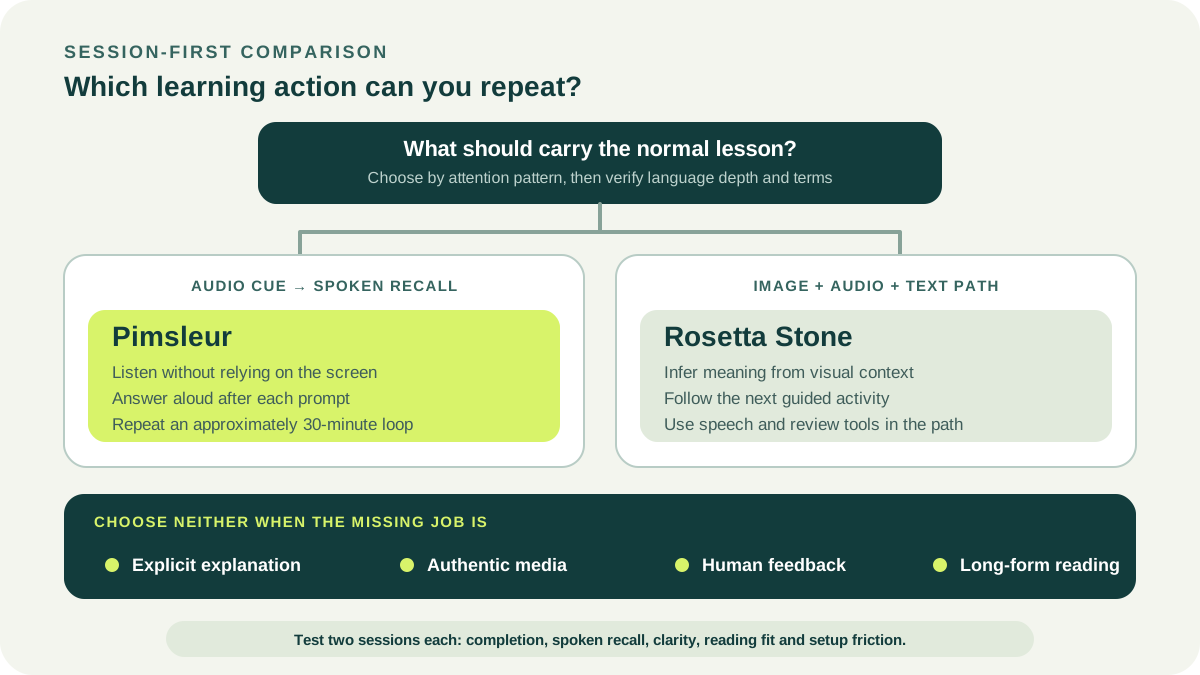
Pimsleur documents its conversational lesson as the core of the method: an approximately 30-minute audio session focused on listening, speaking and recall. The company recommends one lesson a day and says it can be divided into shorter sittings. The mobile app can download lessons for offline use, while the browser version streams them. That makes the normal learning action easy to define: listen, wait for the prompt and answer aloud.
Rosetta Stone's current individual product centres a learning path using images, audio and text, with TruAccent speech recognition, Chat Missions and flashcard sets. Its stated Dynamic Immersion approach limits translation and asks the learner to infer meaning from context. The ordinary session is therefore a sequence of visual and spoken prompts rather than one continuous audio lesson.
Neither format is automatically more rigorous. The useful question is which kind of attention survives your real week. If screen time is the recurring barrier, more visual tools do not solve it. If an extended audio sequence makes you postpone every session, hands-free access has little practical value.
Choose Pimsleur when speaking from an audio cue is the main job
Pimsleur is the clearer shortlist when you want the programme to supply a spoken cue, leave space for a response and repeatedly return to earlier language. The format can work well during a predictable walk or other low-interruption block, provided the activity is safe and you can actually answer aloud. Passive background playback is not the documented lesson loop.
The official FAQ says Reading Lessons are separate from the conversational lessons and use a phonetic approach. Premium formats add written review tools such as flashcards, quizzes, a transcript-based role play and Voice Coach. Those additions widen the practice mix, but the product remains anchored in the conversational audio lesson. A learner whose primary goal is extended reading should inspect the exact course depth and reading material before treating the name of the feature as a complete reading programme.
Choose Pimsleur only if the target-language programme has enough levels for your next objective. Its All Access format currently covers 51 languages, while the FAQ says the number of lessons varies and that many popular languages have 150 lessons. Catalogue breadth is not evidence that every language has equal depth.
- You can protect an approximately 30-minute listening-and-response block
- Answering aloud from an audio cue is more useful than choosing among screen activities
- The exact target-language course extends far enough for the next goal
- Offline mobile audio materially improves whether sessions happen
Choose Rosetta Stone when visual context and a set path reduce friction
Rosetta Stone is the clearer shortlist when pictures, written forms and audio together make a guided path easier to follow. Its current subscription page documents access to all 25 languages, immersive lessons, TruAccent, conversation activities and more than 500 flashcard sets. The learner can begin with the next activity rather than organise a separate audio routine.
The visual contextual approach can suit a beginner who prefers to infer meaning through examples. It can also frustrate someone who wants a concise rule when a pattern is unclear. Use the first available activities to test whether the intended meaning is recoverable without repeated guessing. Product claims about learning intuitively are not a guarantee that this support style fits every learner.
TruAccent and other speech prompts can increase the number of spoken attempts. They do not become a teacher who understands the intended meaning, diagnoses a recurring communication breakdown or adapts the full session. If that responsive diagnosis is the reason to pay, compare live tutoring rather than awarding either app a job it does not document.
- A visible next lesson removes more friction than an audio schedule
- Images, text and audio together make new material clearer
- Short screen-based activities fit the actual study windows
- One subscription covering the required languages is genuinely useful
Reading support is not the same kind of reading course
Both products include written-language activity, but neither should be selected from a single checkbox. Pimsleur separates phonetic Reading Lessons from its conversational audio course and adds visual practice in Premium. Rosetta Stone places text inside a broader image, audio and speech path. Inspect a representative activity in the exact language, especially when the writing system differs from the one you already use.
For a reading-centred goal, define the text you want to handle: messages, graded stories, news or literature. Then ask whether the product supplies sustained practice with that text type. Recognising a written answer inside a lesson can support reading, but it does not prove readiness to follow a new paragraph without the app's prompt structure.
Choose neither as the primary reading tool when you already understand the course prompts but rarely meet connected text. A graded reader or an input platform may own that job more directly, while either course remains optional support for pronunciation or structured review.
Compare the exact language and the next 30 sessions
Pimsleur's All Access catalogue currently contains 51 languages; Rosetta Stone's current individual subscription includes 25. A larger number only matters when it includes a language you plan to study. For one target language, depth, level placement and the next usable activity are more important than the platform-wide count.
Open the exact programme and inspect what follows the beginner material. Pimsleur says programme length varies by language. Rosetta Stone presents one all-language subscription but does not imply identical course depth in every language on its purchase page. Do not convert access to a language into an unsupported CEFR outcome.
Write the next 30-session job before purchase. Examples include responding to travel prompts without notes, completing a beginner path without translation or improving sound-letter correspondence in a new script. Reject either product when its documented activity does not repeatedly train that job.
Trial, guarantee and cancellation are different decisions
Pimsleur documents a seven-day free trial for eligible subscription routes. It says the subscription renews automatically unless cancelled before billing and that deleting the app does not cancel. Purchase channel matters: direct, Apple and Google subscriptions follow different management steps. A paid digital purchase has different terms from a subscription.
Rosetta Stone's US purchase page showed $19.99 billed monthly or $159 billed yearly on 10 September 2026, with a 14-day money-back guarantee. Its support page says direct Sapphire subscriptions have a 14-day satisfaction guarantee and that cancellation or refund steps vary by purchase channel. This is a paid purchase with a possible refund, not a no-charge trial.
Record the amount charged today, renewal date, cancellation channel and refund deadline before starting. Prices and offers can change by market or channel, so verify the checkout rather than relying on an older article. Both merchant buttons on this page are ordinary non-affiliate links; commission does not affect the recommendation.
Run a two-session attention test—or choose neither
Test each product twice with comparable beginner material. For Pimsleur, note whether you completed the audio segment, answered aloud and could recall three useful responses the next day. For Rosetta Stone, note whether the visual prompts were clear, how much you spoke and whether the next activity was obvious. This is a personal fit check, not an experiment that proves language gains.
Score completion, focused minutes, useful spoken retrieval, clarity of meaning, reading fit and setup friction. Prefer the method with the repeatable session, provided its language depth and billing terms also fit. Do not keep both merely because they felt different; a second subscription needs a separate recurring job.
Choose neither when you need detailed explanations, sustained authentic input, writing feedback or a human partner who can respond to unpredictable language. Use the Method Finder to compare method families, then reserve the Listening Input Calculator for a plan based on actual minutes rather than a promised fluency date.
Decision criteria
Primary sources
Material claims link to primary or authoritative sources. A link is not an endorsement.
- Pimsleur — conversational lessons, formats, access and billing rules
- Pimsleur — current language catalogue
- Rosetta Stone — current plans, languages and learning features
- Rosetta Stone — current cancellation and satisfaction-guarantee terms
- Pimsleur: Languages
- Pimsleur: Plans and trial
- Pimsleur: Official offer
- Rosetta Stone: Plans and features
- Rosetta Stone: Subscription support