Time calculator
Listening Input Calculator
See how a realistic listening routine adds up across a week, month and year—without unsupported fluency claims.
Set your listening rhythm
Count planned exposure, then decide how much will be focused.
Your exposure map
Simple time arithmetic; no unsupported fluency forecast.
Your totals will appear here
Use the result to protect a realistic weekly block.
Choose what belongs in your listening time
An hours total does not select an app. Keep useful materials you already have; compare a different format only when it solves a specific listening problem.
Watch the worked example · 8 min 21 sec
Is 30 minutes a day enough to learn a language?
See how five study days become 130 planned hours a year, and why a mixed study session is not the same as listening time. The video separates time planning from promises about fluency or a CEFR level.
Loading the player connects to YouTube (Google), which may process device and usage data. The player stays off until you choose to load it.
Short explanations for your listening plan
Choose a quick example, then try its assumptions in the calculator above.
Loading a video connects to YouTube (Google), which may process device and usage data. No player loads until you choose one.
30 Minutes a Day = 130 or 182 Hours?
Compare five-day and seven-day schedules before choosing your weekly target. 29 sec
Your 30-Minute Study Session May Only Include 15 Minutes of Listening
Separate listening minutes from the rest of a mixed study session. 29 sec
Use the result well
How to turn this estimate into a decision
Thirty minutes a day: 130 or 182 hours?
Both totals can be correct; they describe different schedules. Enter the minutes you actually intend to spend listening, then the number of listening days in a normal week. These are planning examples calculated with this tool’s 52-week year, not measured learning outcomes.
- 30 minutes × 5 days = 150 minutes, or 2.5 hours a week: 130 hours across 52 weeks.
- 30 minutes × 7 days = 210 minutes, or 3.5 hours a week: 182 hours across 52 weeks.
- 15 listening minutes within a mixed 30-minute study session × 5 days = 75 minutes a week: 65 listening hours across 52 weeks.
The calculation is simple on purpose
The tool multiplies minutes per listening day by days per week, then uses 52 weeks for the annual total and one-twelfth of that annual figure for an average month. It does not translate exposure hours into a CEFR level or a guaranteed result.
Use the total to test whether a routine is real. A plan that requires ninety minutes every day can look impressive in a calculator and still fail in the first busy week.
- Protect a minimum session for difficult days.
- Keep one or two longer sessions for sustained attention.
- Track completed sessions as well as planned minutes.
Count listening time without counting it twice
Use elapsed time spent listening, including intentional replays. A ten-minute clip played twice is twenty minutes of listening but only ten minutes of unique material. Reading silently, choosing a show, looking up words with the audio paused and speaking practice belong in your wider study log, not this listening total.
Listening while reading the matching transcript is one block of time, not separate listening and reading blocks to add together. If you track background audio, label it separately from focused practice; this calculator does not assign an effectiveness score to either.
The annual result assumes the same schedule for all 52 weeks. For a planned four-week break, 30 minutes on five days during each of the remaining 48 weeks gives 120 hours. An average month is not a promise about any particular calendar month.
Separate focused listening from easier volume
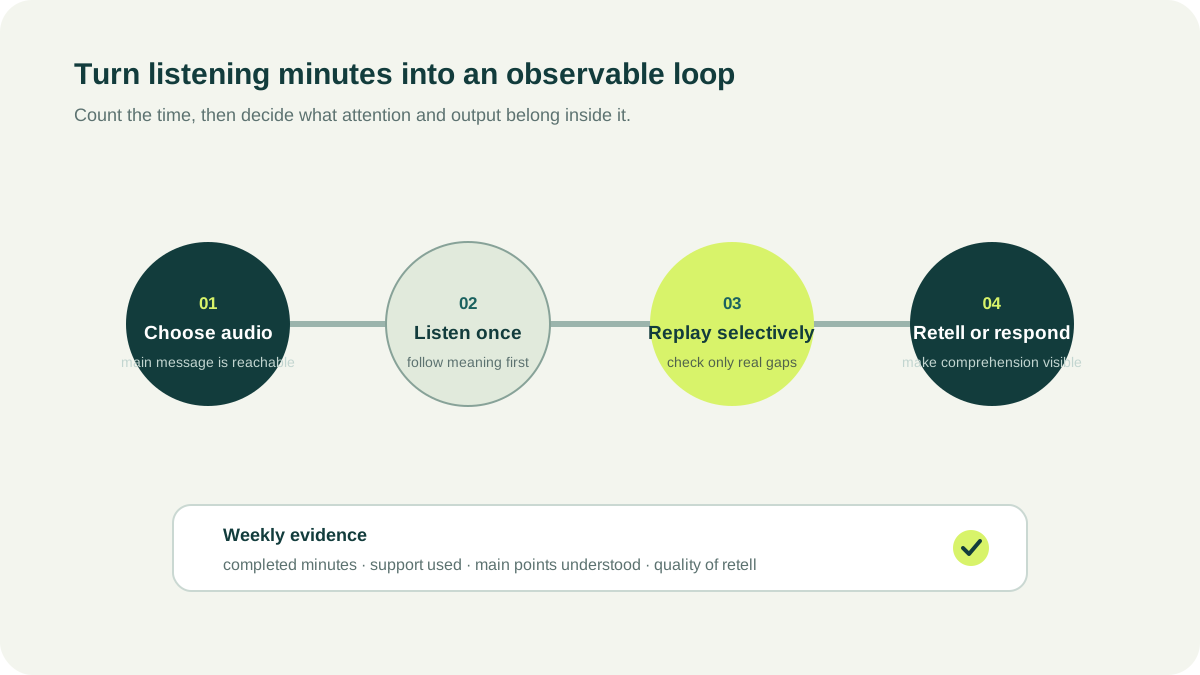
Focused listening may include a first pass for meaning, selective replay, a transcript check and a short retell. Easier listening can increase contact time without the same analysis. Both can be useful, but they are not interchangeable.
If every sentence requires a lookup, lower the difficulty or add context. If the audio never requires attention, increase speed, topic range or accent variety one variable at a time.
Measure comprehension without fake precision
Choose an observable outcome: identify the main point, order the events, answer a few content questions or give a short oral summary. Note whether you needed subtitles, a transcript or repeated playback.
Revisit the same type of task after several weeks. Less support, faster recovery after a missed phrase and a more accurate retell are useful signals even when a formal level has not changed.
Use the total to choose support, not buy a fluency promise
Before paying for another app, identify the obstacle in one actual session. If you cannot follow the audio, look for easier material and useful text support. If you keep abandoning the material, compare formats you would realistically return to. If you understand but cannot respond, adding more listening alone may not address your speaking goal.
The LingQ vs LingoPie comparison above is a starting point for choosing between text-and-audio and video-led workflows, not an instruction to subscribe to both. Check target-language coverage and the current plan limits on the linked decision pages. Keep an existing resource when it already does the job.
For a level-based goal, use the CEFR planner separately. Cambridge English describes approximate guided learning involving lessons and supervised study, with substantial learner variation. This listening-exposure total cannot be substituted for those hours or converted into a guaranteed CEFR date.
Sources and evidence boundary
Planning tools provide decision support, not a promise of a learning outcome.