Flagship decision tool
Language Method Finder
Turn your language, level, goal, available time and budget into a defensible learning-method shortlist.
Build your brief
Five inputs. No account, email or hidden commission weighting.
Your decision map
Matches explain both the fit and the limitation.
Your shortlist will appear here
Recommendations use the visible rules below—not affiliate commission.
- Goal-to-format match
- Level and structure fit
- Session length
- Budget model
Watch the worked example · 9 min 24 sec
Which language-learning method fits you?
Follow the five-input walkthrough: target language, level, learning goal, session time and budget. Use it to understand a shortlist before choosing an app, then try the finder with your own constraints.
Loading the player connects to YouTube (Google), which may process device and usage data. The player stays off until you choose to load it.
Short examples for a better shortlist
Explore one constraint at a time, then adjust the finder above to match your own situation.
Loading a video connects to YouTube (Google), which may process device and usage data. No player loads until you choose one.
The “Best Language App” Question Is Backwards
Start with the learning job you need to do before comparing app names. 34 sec
A 15-Minute Beginner Shortlist—Using Real Constraints
See how a short beginner session shapes a practical shortlist. 42 sec
Change One Input. Change the Whole Shortlist.
Change a single constraint and compare the resulting options. 46 sec
Why Your Target Language Changes the Shortlist
Check language coverage before weighing the remaining method choices. 42 sec
Use the result well
How to turn this estimate into a decision
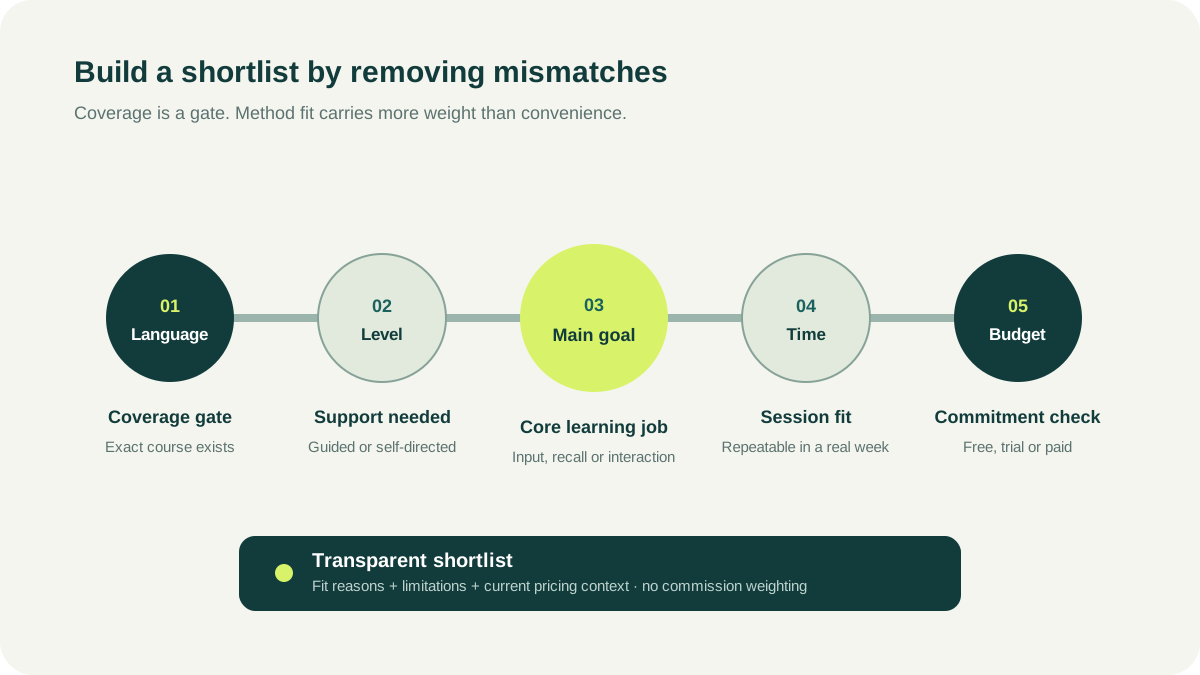
What the finder actually weighs
Language coverage is the first gate. The remaining products are compared by their documented core activity: structured lessons, listening, reading, video, spoken recall or live tutoring. Level, session length and budget then adjust the shortlist.
The result is a fit map, not a claim that one app is universally best. Affiliate status and commission are absent from the scoring rules.
- Confirm the exact course exists for your target language.
- Choose the repeated learning activity before comparing feature counts.
- Treat price and session length as constraints, not proof of quality.
Run a fair trial
Use the same learning job during each trial: for example, understand one short clip, complete one guided lesson or hold one scheduled conversation. Compare setup time, feedback, comprehension and whether the next action is obvious.
A permanent free tier, a sample lesson, a card-required trial and a money-back guarantee are different forms of access. Record the charge date and cancellation channel before you begin.
- Test the same language and level.
- Use a fixed session length.
- Write down one strength, one limitation and the total commitment.
Build the smallest useful stack
Start with one primary tool. Add a second product only when it owns a separate weekly job, such as live speaking alongside independent listening. Two subscriptions that both fill unplanned browsing time usually create cost without a clearer routine.
Review the choice after several real sessions. If the method fits but the habit fails, change the trigger or session size before changing products again.
Planning tools provide decision support, not a promise of a learning outcome.