Best for
- Busy learners who can protect one focused half-hour
- Beginners combining a structured lesson with easy listening
- Intermediate learners turning input into recall and response
Watch for
- A fixed split should change when the goal or level changes
- Thirty minutes every day is not a guaranteed proficiency timeline
- Opening several apps can consume the session before learning begins
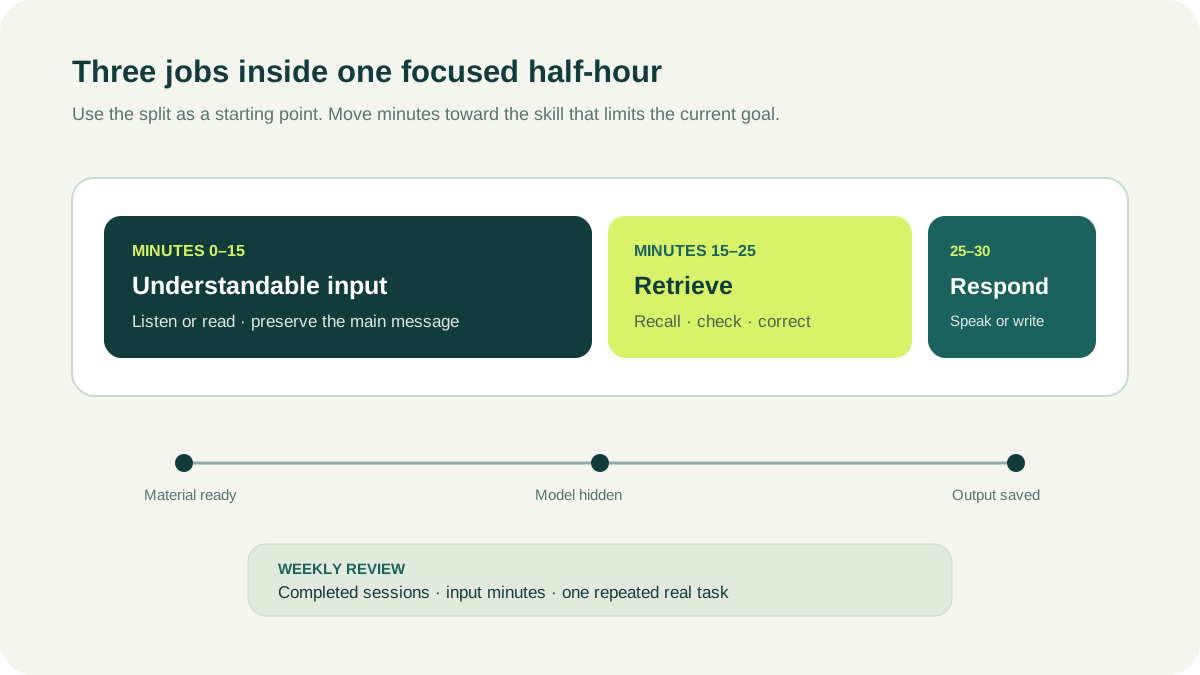
Prepare the session before the timer starts
Choose the lesson, audio, transcript or text in advance. Put the response prompt beside it and decide what completion means—for example, follow the main message, retrieve ten phrases or record a one-minute summary.
The Open University recommends separating focused study time from lower-attention exposure during otherwise unused moments. Treat this half-hour as focused work; commuting audio can be additional exposure rather than a substitute for every deliberate task.
Minutes 0–15: process understandable language
Use one short lesson, graded text, transcript-supported clip or familiar podcast segment. The main message should remain available even when some forms are new.
Replay or look up selectively. If every sentence stops the flow, lower the difficulty or add support. If nothing requires attention, increase topic complexity, speed or independence one variable at a time.
Minutes 15–25: retrieve what matters
Close or hide the source and recall a small set of useful phrases, sentence patterns or key ideas. Then check the original and correct only the gaps that affect meaning or the week's goal.
Vocabulary review works best here when words come from the input block rather than an unlimited unrelated list. Keep the queue small enough that retrieval leaves time for using the language.
Minutes 25–30: produce an unprompted response
Retell the main point, answer a question aloud, write several connected sentences or send a prepared voice message. The response can be brief; its job is to reveal what remains available without the model.
Save one response each week and repeat the task later with less preparation or support. This is evidence of changing performance, not a formal CEFR assessment.
Adjust the split by level and goal
A beginner may use 15 minutes of structured lessons, 10 minutes of easy audio and five minutes repeating or adapting core phrases. An intermediate learner may use 20 minutes of connected input, five minutes of phrase review and five minutes of summary.
For conversation preparation, shift five minutes from input to response. For a listening bottleneck, keep the full input block and use retrieval to reconstruct what was heard. The four planning tools can calculate total exposure and test whether the weekly promise is realistic.
- Beginner: structure 15 · easy input 10 · response 5
- Intermediate input focus: input 20 · retrieval 5 · response 5
- Speaking focus: input 10 · retrieval 5 · active use 15
- Reading focus: reading 20 · vocabulary in context 5 · written summary 5
Use a ten-minute fallback instead of losing the day
On a disrupted day, use five minutes of familiar input, three minutes of retrieval and two minutes of response. The fallback protects the learning jobs without pretending it equals a full session.
Review the week by completed sessions, total listening or reading time and one real task. If the plan repeatedly fails, change the trigger, material or number of study days before buying another app.
Choose software only for the input block it supports
The 15/10/5 allocation is an editable example, not a research-backed optimum. A free text, podcast or video can run the whole routine. Consider an integrated platform when switching among playback, lookup and review consumes the available time.
Affiliate disclosure. Links to LingQ and LingoPie in this decision area are affiliate links. We may earn a commission if you buy through them. This does not affect our recommendations. How we fund the Lab
LingQ: Reading version: use one manageable text with audio during the input block, select a few phrases for retrieval, then write or record a response outside the source.
Explore LingQLingoPie: Video version: use one short scene with selective subtitle help, retrieve its key phrases, then retell the situation. Do not spend the full half-hour browsing the catalogue.
Explore LingoPieDecision criteria
Primary sources
Material claims link to primary or authoritative sources. A link is not an endorsement.