Best for
- Buyers deciding between media-led input and a guided course
- Beginners checking how much structure and translation support they need
- Learners comparing two all-language purchase models without assuming the methods are equivalent
Watch for
- LingoPie catalogue depth and feature availability vary by language, interface, region and device
- Rosetta Stone's contextual method may frustrate learners who want frequent explicit explanations
- A free trial and a money-back guarantee create different payment and cancellation risk
Products in this decision
Affiliate disclosure. Links to LingoPie in this decision area are affiliate links. We may earn a commission if you buy through them. This does not affect our recommendations. How we fund the Lab
LingoPie
DocumentedA video-first platform using shows, films and short-form media with interactive subtitles and playback tools.
Best fit: Visual learners who stay engaged with series and films
Watch: It is not a conventional linear CEFR course
Rosetta Stone
DocumentedA picture-and-audio immersion programme with pronunciation feedback and minimal reliance on translation.
Best fit: Visual beginners comfortable learning through context
Watch: Limited translation can frustrate learners who want explicit explanation
Side-by-side evidence
Product facts use the documented vendor records; pricing has its own verification date below. Regional offers may change.
Scroll across to compare product details. Prices and billing terms should be confirmed on the official site.
| Criterion | LingoPie | Rosetta Stone |
|---|---|---|
| Learning format | video, listening, vocabulary, reading | structure, listening, speaking, vocabulary |
| Languages | 17 published target languages; catalogue availability can vary by interface language and region | 25 languages on current Sapphire plans |
| Level context | Personalised level selection, without a published universal CEFR pathway | Beginner-focused; no universal consumer-course CEFR ceiling is published |
| Access model | Time-limited trial | Money-back guarantee |
| Free access / trial | Eligible web and US iOS card purchases have a seven-day trial; the monthly mobile plan has no trial | No confirmed permanent free plan; direct plans advertise a 14-day money-back guarantee |
| Pricing context | No universal numeric quote: check the current regional checkout for term, language access, full charge, trial eligibility and renewal | Sapphire was listed at $19.99 monthly or $159 annually for all languages |
| Pricing checked | Sep 9, 2026 | Sep 9, 2026 |
| Billing / renewal context | The seven-day trial auto-renews; current-month and post-trial annual charges are described as non-refundable | A money-back guarantee is not the same as a no-charge free trial |
| Platforms | Web, iOS, Android and selected TV platforms; iOS supports limited offline downloads | Web, iOS, Android and macOS |
The word immersion does not make these products alike
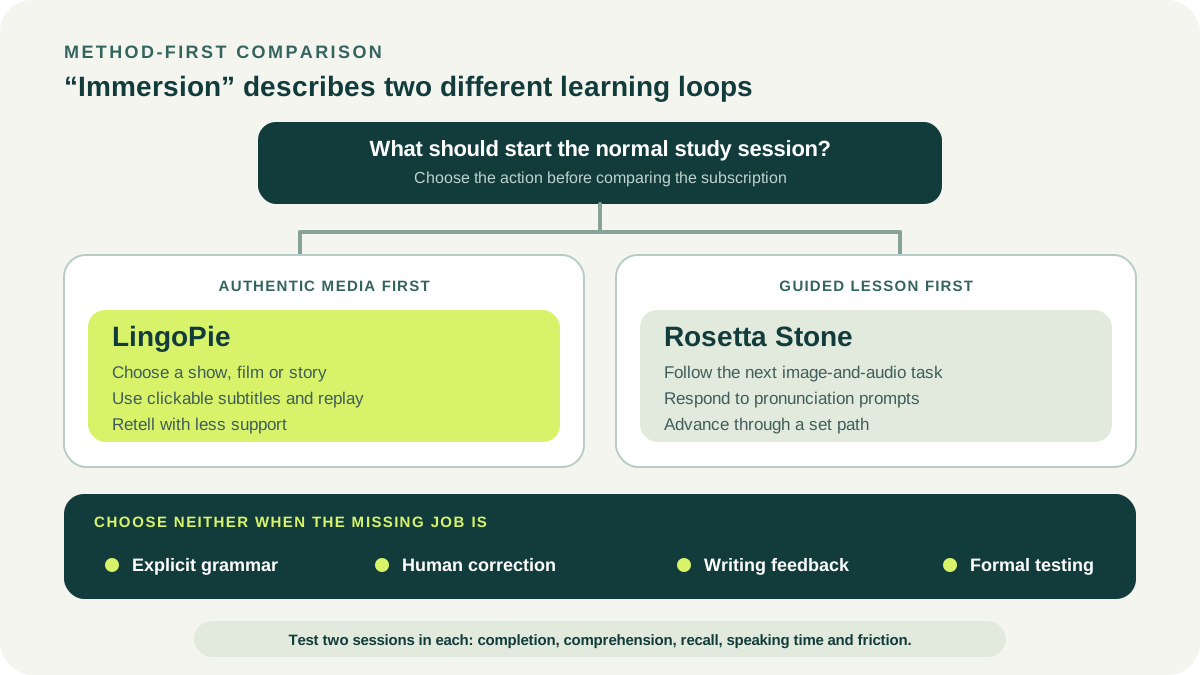
LingoPie's current product pages centre real-world TV, films, stories, news and audio. Clickable and dual subtitles, saved vocabulary, quizzes and playback controls provide support inside that media. The learner normally chooses content first and decides how intensively to study it.
Rosetta Stone's current consumer offer centres a learning path using images, audio and text, with TruAccent speech recognition, conversation activities and topic vocabulary. The platform chooses a progression and asks the learner to infer meaning through contextual prompts rather than begin with an entertainment catalogue.
This is therefore a method decision before it is a brand decision. Pick authentic-media comprehension when following real scenes will sustain attention; pick sequenced course activity when a clear next lesson and repeated spoken response remove more friction.
Choose LingoPie when authentic media is the weekly anchor
Choose LingoPie when the recurring task is to understand a show, film or story in the target language and gradually reduce reliance on subtitle support. Its documented tools keep definitions, saved words and review close to the scene, which can preserve the connection between a phrase, the speaker and the situation.
The official language help page currently lists 17 learning languages, but also says the catalogue, content and available features update when the selected language changes. Check several suitable titles in the exact language and interface combination rather than treating a platform-wide language count as evidence of equal depth.
Media choice creates responsibility. A learner can spend the whole session browsing or reading translations. Define one completion rule: follow a manageable scene, save only a few useful phrases, replay one exchange and finish with a short retell. If that loop is not repeated, the larger catalogue is not producing more useful practice.
- A show or story is more likely than a lesson sequence to start the session
- Clickable subtitles are necessary to keep difficult media understandable
- The exact target-language catalogue contains several suitable next sessions
- Listening comprehension is a larger gap than course progression
Choose Rosetta Stone when guided lessons reduce friction
Choose Rosetta Stone when a predefined path is more useful than choosing media. The current consumer page documents access to 25 languages, immersive lessons, TruAccent pronunciation feedback, Chat Missions and flashcard sets. The central loop is to complete the next structured activity rather than assemble a routine around an episode.
This can be the clearer starting point for a beginner who needs controlled vocabulary, frequent prompts and a visible sequence. Rosetta Stone's contextual approach intentionally limits reliance on translation, so test whether pictures and examples make the meaning clear enough. A learner who repeatedly wants a direct grammar explanation may need a different structured course.
Speech recognition can prompt frequent spoken production and immediate machine feedback, but it is not the same as a teacher diagnosing meaning, register or an unscripted conversational problem. If responsive correction is the main purchase reason, compare live tutoring instead of assuming pronunciation technology fills that role.
- A prescribed next lesson is more valuable than an open media catalogue
- Image-and-audio prompts feel clearer than subtitle-led authentic content
- Frequent pronunciation attempts belong in the normal session
- The required language is present in the current 25-language offer
Beginner fit depends on the support ladder
For a new learner, test how support changes after the first answer. Rosetta Stone can begin with tightly controlled images and audio, then reuse language across activities. LingoPie can provide beginner-oriented material and translation support, but real media can still contain denser vocabulary, faster delivery and more cultural assumptions.
Use a four-step support ladder: meaning visible, meaning hinted, target-language cue only, then unsupported recall. The stronger fit is not the product that makes the first answer easiest; it is the one that lets you remove support without losing the task.
Intermediate learners should reverse the question. If controlled course material is already easy, LingoPie's authentic catalogue may create the more useful listening challenge. If media exposure is plentiful but production remains hesitant, Rosetta Stone's speaking prompts or a human conversation activity may address a more specific gap.
Language count and device support are gates, not verdicts
Rosetta Stone's current individual plan says one subscription includes all 25 listed languages. LingoPie's help centre currently lists 17 learning languages, while its plan documentation distinguishes access conditions across terms. Multi-language access is useful only if the buyer intends to use it and the desired material exists.
Device needs can break a theoretical match. Rosetta Stone documents mobile offline units that remain available for a limited period and sync after reconnection. LingoPie offers web, mobile and selected TV access, which can be a stronger living-room fit but still requires checking whether the intended learning controls work on that device.
Before paying, open the exact course or catalogue on the device that will carry most sessions. Reject a product when access is technically available but the next several appropriate activities are not obvious.
Compare payment risk as carefully as method fit
Rosetta Stone's US consumer page showed $19.99 billed monthly or $159 billed yearly on 9 September 2026, with all 25 languages. It describes a 14-day money-back guarantee, not a no-charge trial. Its support page says cancellation follows the original purchase channel and direct Sapphire subscriptions have a 14-day satisfaction guarantee.
LingoPie's current help centre describes a seven-day trial for eligible web and iOS purchases, plus monthly, quarterly, yearly, family and lifetime structures with different language access and renewal rules. The monthly mobile plan is specifically documented without that trial. Because price and eligibility can vary by channel and region, verify the actual checkout rather than copying an advertised saving.
Record the amount charged now, included languages, trial or refund deadline, renewal interval and cancellation channel. The labelled LingoPie merchant button is an affiliate link; Rosetta Stone remains an ordinary link. Commission does not affect the verdict.
Choose neither—or test both without buying both
Choose neither when the missing job is explicit grammar instruction, sustained writing feedback or live conversation with adaptive correction. A different course or tutor can solve those needs more directly than either documented core workflow.
For a controlled comparison, run two 20-minute sessions in each product. In LingoPie, follow one manageable scene, look up only blocking phrases and retell it. In Rosetta Stone, complete one lesson segment, note how often meaning remains uncertain and repeat the speaking prompts. The next day, repeat a related task with less support.
Score completion, understandable input, useful recall, speaking time, setup friction and whether the next session is obvious. Choose one primary platform when it creates the more repeatable loop. Keep both only when one owns course progression and the other owns deliberate authentic-media practice—and the total annual cost remains intentional.
Decision criteria
Primary sources
Material claims link to primary or authoritative sources. A link is not an endorsement.
- LingoPie — current media workflow and device overview
- LingoPie — current supported languages and interface combinations
- LingoPie — current plans, access and renewal structure
- Rosetta Stone — current individual plans, languages and features
- Rosetta Stone — current cancellation and satisfaction-guarantee terms
- Rosetta Stone — current mobile offline conditions
- LingoPie: Supported languages
- LingoPie: Trial terms
- LingoPie: Plans and purchase-channel conditions
- Rosetta Stone: Plans and features
- Rosetta Stone: Subscription support