Best for
- Learners who understand text better than speech
- Commuters building an audio routine
- Intermediate learners moving toward native-speed content
Watch for
- Passive playback is not the same as attentive practice
- Transcript support varies
- Audio depth differs by language
Documented shortlist
Affiliate disclosure. Links to LingoPie and LingQ in this decision area are affiliate links. We may earn a commission if you buy through them. This does not affect our recommendations. How we fund the Lab
Pimsleur
DocumentedAn audio-first programme centred on recall, speaking and listening in roughly 30-minute lessons.
Best fit: Audio learners and commuters
Watch: Reading and writing are secondary to audio
LingoPie
DocumentedA video-first platform using shows, films and short-form media with interactive subtitles and playback tools.
Best fit: Visual learners who stay engaged with series and films
Watch: It is not a conventional linear CEFR course
LingQ
DocumentedA self-directed reading and listening environment built around authentic content, saved words and imported material.
Best fit: Learners who want large amounts of reading and listening input
Watch: The open library is not a mandatory linear course
Babbel
DocumentedA structured lesson platform with short dialogues, grammar explanations, speaking practice and review.
Best fit: Learners who want a guided course rather than an open content library
Watch: Course depth is not equal across languages
Busuu
DocumentedA structured course platform with short lessons, study plans and corrections from a learner community.
Best fit: Learners who want a CEFR-oriented course sequence
Watch: Language coverage and level ceilings differ
Side-by-side evidence
Product facts use the documented vendor records; pricing has its own verification date below. Regional offers may change.
Scroll across to compare product details. Prices and billing terms should be confirmed on the official site.
| Criterion | Pimsleur | LingoPie | LingQ | Babbel | Busuu |
|---|---|---|---|---|---|
| Learning format | listening, speaking, structure | video, listening, vocabulary, reading | reading, listening, vocabulary, structure | structure, speaking, listening, vocabulary | structure, speaking, listening, vocabulary |
| Languages | 51 languages; the number of levels varies by language | 17 published target languages; catalogue availability can vary by interface language and region | More than 50 languages; the verified selector contained 52 | 13 target languages from English; course depth differs substantially by language | 14 languages; the published course ceiling ranges from A2 to C1 |
| Level context | Beginner through intermediate in the deepest courses; no universal CEFR equivalence is published | Personalised level selection, without a published universal CEFR pathway | All levels are marketed; the open content model is often easiest after the earliest beginner stage | From beginner upward; the published ceiling ranges from A1 to C1 depending on language | Strongest where the chosen language has a complete A1–C1 path |
| Access model | Time-limited trial | Time-limited trial | Permanent free tier | Free sample | Permanent free tier |
| Free access / trial | Seven-day trial for eligible subscriptions, converting to paid access unless cancelled | Eligible web and US iOS card purchases have a seven-day trial; the monthly mobile plan has no trial | Free account with audio and transcripts, up to 20 saved terms, five imported lessons and one playlist | Registration and the first lesson of each course are free; no universal timed trial was confirmed | Basic course access, community feedback and basic progress tracking |
| Pricing context | All Access was listed at $20.95 per month after the free week | No universal numeric quote: check the current regional checkout for term, language access, full charge, trial eligibility and renewal | USD web Premium snapshot: $14.99 monthly, $119.99 for 12 months or $215.76 for 24 months; terms are prepaid and locale/channel can change the offer | No stable universal public number; price varies by location, term, promotion and direct, Apple, Google or partner purchase channel | Current numeric pricing was not reliably exposed in public vendor HTML; verify at checkout |
| Pricing checked | Sep 3, 2026 | Sep 9, 2026 | Sep 13, 2026 | Sep 3, 2026 | Sep 3, 2026 |
| Billing / renewal context | Single-language, All Access and lifetime options vary; direct subscription availability is limited by country and store terms can differ | The seven-day trial auto-renews; current-month and post-trial annual charges are described as non-refundable | Recurring prepaid plans; first-time Premium purchases have a published 30-day refund window, while later charges are generally non-refundable | Cancel through the original purchase channel before its stated renewal deadline; regional withdrawal and refund rights differ | One- to 12-month terms are paid upfront and auto-renew; the first Premium payment has a published 14-day guarantee, excluding renewals |
| Platforms | Web, iOS and Android with hands-free and offline app use | Web, iOS, Android and selected TV platforms; iOS supports limited offline downloads | Web, iOS and Android; offline access is a Premium feature | Web, iOS and Android with synced progress | Web, iOS and Android; offline access requires Premium |
Guided audio recall
Pimsleur controls the prompt, pause and expected spoken response. This is listening tied to retrieval, not an open library for extensive input.
It suits a learner who can protect a roughly 30-minute audio block. It is less suitable when the main need is reading, writing or choosing large amounts of authentic content.
Transcript-supported listening
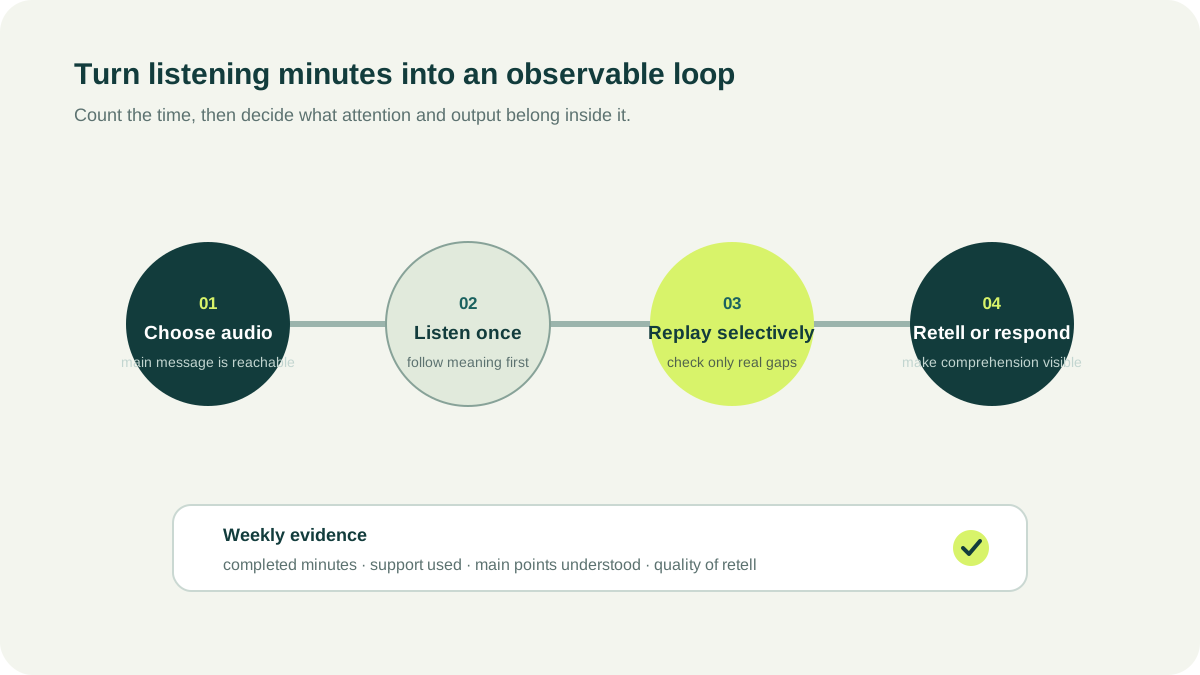
LingQ links text, audio and saved terms and can accept imported material. This supports a loop of first-pass listening, transcript check and repeated contact with the same language.
The learner must still judge difficulty and source quality. A transcript can support meaning or become a substitute for listening, depending on when it is opened.
Video-context listening
LingoPie uses visual context and interactive subtitles around shows and other video. The scene can make natural speech more reachable, especially when gesture and situation carry meaning.
Catalogue depth, regional licensing and language availability should be checked before a long commitment. Passive viewing hours are not equivalent to focused comprehension work.
Extensive listening and live turn-taking
Easier podcasts, stories or public media can build volume without a subscription. Live tutoring adds the pressure of responding to another person, which no replay control reproduces.
Choose the bottleneck: understanding prepared content, following natural media, recalling a response or negotiating meaning in real time.
Use one repeatable measurement
Track first-pass main-point understanding, support used and the quality of a short retell or response. Do not convert total exposure hours into a guaranteed level.
The Listening Input Calculator sizes the habit; the Language Environment Planner prevents listening from silently removing reading, review and active use.
Match the listening format to the place you will use it
A desk session can accommodate a transcript and selective lookup. A screen-free walk needs audio you can follow without repeatedly reaching for text. A planned video session can use visual context, but should have a clear stopping point. Choose the real setting before comparing subscriptions.
For LingQ, check one intended text-and-audio item and whether preparing it fits your available time. For LingoPie, inspect the subtitle options for the exact interface language, target language and device. The existence of a language in a headline list does not establish that every subtitle combination or device feature is available.
- Keep a transcript as a rescue step when sound recognition is the goal; try a short first pass without reading it.
- Use a video scene when visual context helps you follow the message; replay a manageable segment instead of accumulating unwatched saved titles.
- Keep an accessible free podcast or existing player when it already supports the listening task. More software is not an outcome.
Check the commitment after choosing the format
Write down the amount charged now, renewal interval and cancellation route for the actual offer you are considering. Do not compare an annual monthly equivalent with a true month-to-month payment, or assume that a sample, free account and trial have the same conditions.
Use the product-specific pricing guides below once the method fits. If the material is still too difficult with support, reduce difficulty before paying for a longer plan. If comprehension is adequate but replying is hard, consider responsive conversation practice rather than a second listening subscription.
Confirm the cost of the listening workflow you chose
After deciding between a prepared text-and-audio queue and a video catalogue, check that product's payment commitment. These guides separate access conditions and billing choices; neither is a reason to replace a useful free listening source.
Decision criteria
Primary sources
Material claims link to primary or authoritative sources. A link is not an endorsement.
- LingQ: reading, audio playlists and imports
- LingoPie: interface, target language and platform conditions
- Pimsleur: Languages
- Pimsleur: Plans and trial
- Pimsleur: Official offer
- LingoPie: Supported languages
- LingoPie: Trial terms
- LingoPie: Plans and purchase-channel conditions
- LingQ: Official pricing
- LingQ: How LingQ works
- LingQ: Subscription terms
- Babbel: Languages and levels
- Babbel: Course structure
- Babbel: Official pricing
- Busuu: Languages and levels
- Busuu: Free and Premium
- Busuu: Premium plans