Best for
- Intermediate learners increasing exposure
- Media-led learners
- People designing an at-home routine
Watch for
- Formal immersion programmes use narrower definitions
- Passive exposure is not a complete plan
- Difficulty can silently exceed comprehension
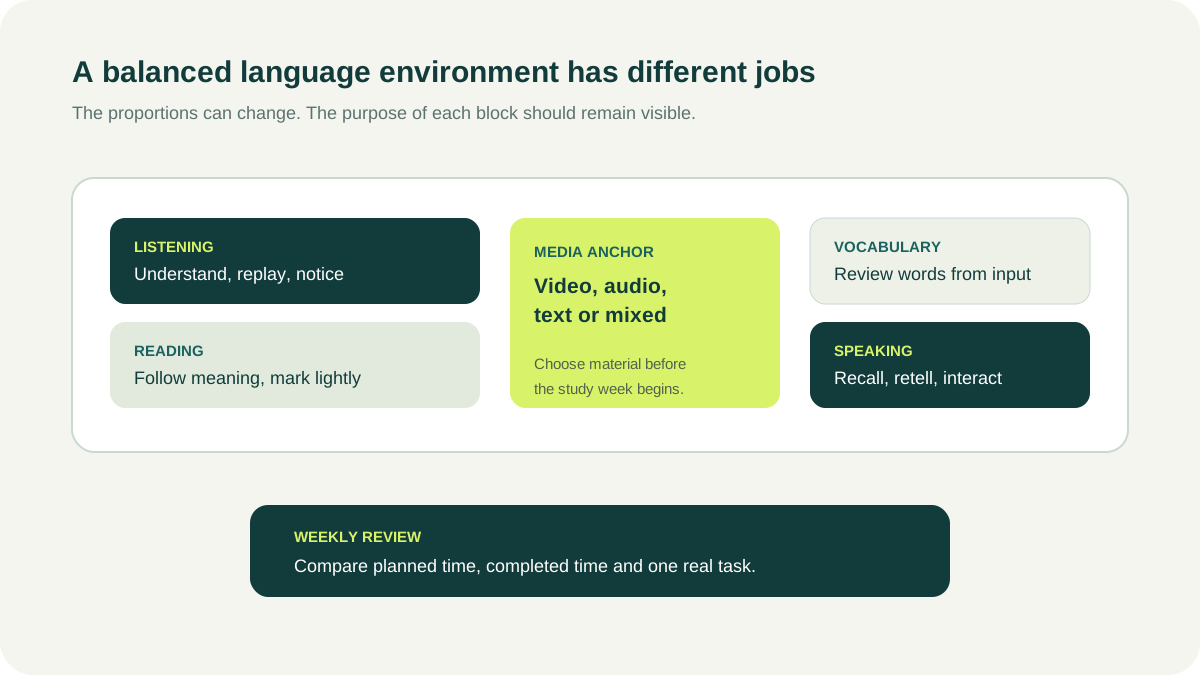
Use ‘at-home immersion’ as a planning label, not a school-program claim
Formal dual-language immersion has a specific educational meaning. The Center for Applied Linguistics describes an immersion programme as using the partner language for at least half of instruction while teaching both language and subject content. Watching media and changing a phone setting at home do not reproduce that programme structure.
For independent study, the more useful definition is a planned language environment: recurring situations in which you understand, retrieve or use the target language. This keeps the method testable without implying that every target-language minute has equal value.
Audit the week before adding activities
Mark the time that can support full attention separately from time already occupied by walking, commuting, cooking or routine chores. A transcript-heavy listening session belongs in the first category; familiar audio that remains understandable without constant lookup may fit the second.
The Open University routine guidance starts from a seven-day schedule and asks learners to fit study around work, family and recurring interruptions. Treat its example durations as prompts rather than universal prescriptions. Use the Immersion Planner to allocate the time you actually have, not the week you hope to have later.
- Focused time: one bounded listening, reading, course or conversation task with a clear finish.
- Lighter exposure: prepared audio or media that remains useful when attention is divided.
- Recovery time: a small fallback session that keeps the next item ready after a disrupted day.
Build a minimum viable seven-day environment
A workable starting week might contain two focused input sessions, one reading or course session, one spoken or written response, one lighter listening appointment and one review. This is an editable planning example, not a research-established optimum. A beginner may need more guided material; an intermediate learner may allocate more time to longer connected input.
Preselect the episode, text, lesson or topic. The appointment should begin with language, not catalogue browsing. Reuse one topic across listening, reading and response when setup time is limited, because each activity can then deepen the same message instead of starting from zero.
- First focused input: follow the main message and note the support required.
- Second focused input: return with less support or a related item at similar difficulty.
- Active-use appointment: retell, answer, write or discuss something from the input.
- Weekly review: record completed appointments and prepare the first item for next week.
Use a support ladder instead of an all-or-nothing subtitle rule
Start with the least support that still protects the main message. Depending on the material, the next step may be target-language captions, an aligned transcript, selective lookup, slower playback or a simpler item. Translation can be a temporary rescue without becoming the entire activity.
Change one difficulty variable at a time: speed, topic familiarity, speaker, text length, vocabulary load or amount of support. If comprehension collapses after several variables change together, the session cannot show which adjustment was responsible.
Make at least one response observable
If conversation is the goal, passive exposure cannot be the only weekly evidence. Use a short retell, a voice note, a written reaction or a live exchange. The response need not be long; it needs to reveal whether useful language can be retrieved without copying the source line by line.
Track the task, support and result rather than claiming that exposure hours guarantee a CEFR level. The Listening Input Calculator can total planned and completed listening time, while the response shows what that total alone cannot.
Keep, change or cancel after an ordinary week
Keep a source or tool when its scheduled job happened, preparation was manageable and the material was appropriately difficult. Change the material when difficulty blocked meaning. Change the time or cue when the task was repeatedly skipped. Cancel overlapping paid access when two services compete for the same appointment.
A reading-and-audio platform such as LingQ and a video platform such as LingoPie can support different lanes, but they do not need to coexist. Use a free podcast, public broadcaster, library item or content you already own when it performs the job. Affiliate availability never makes a subscription necessary.
Give an input subscription one job in the environment
Build the environment around activities, not subscriptions. Free radio, library books and conversation can remain the foundation. Add a paid platform only when its support makes an otherwise difficult activity repeatable; it cannot replace every form of interaction.
Affiliate disclosure. Links to LingQ and LingoPie in this decision area are affiliate links. We may earn a commission if you buy through them. This does not affect our recommendations. How we fund the Lab
LingQ: Choose a reading-and-listening lane when you already have material you want to work through. Prepare tomorrow's text before today's session ends.
Explore LingQLingoPie: Choose a video lane when a suitable series is a reliable cue to start. Keep one scene for replay and a brief retell rather than counting background viewing as focused study.
Explore LingoPieDecision criteria
Primary sources
Material claims link to primary or authoritative sources. A link is not an endorsement.
- Center for Applied Linguistics — Dual-language and immersion terminology
- Open University — Establishing an effective language-learning routine
- Open University — Creating virtual immersion through a smartphone
- LingQ: Official pricing
- LingQ: How LingQ works
- LingQ: Subscription terms
- LingoPie: Supported languages
- LingoPie: Trial terms
- LingoPie: Plans and purchase-channel conditions